
William Benjamin Powell is an independent creative with a UX design background, working on website assets and animations for clients on a project-by-project basis.
His original setup paired a heavyweight motion graphics tool with a separate encoder for export, and shipped deliverables as GIFs, a format that didn't suit the scalable, SVG-native web work his clients increasingly wanted.
This case study walks through how he rebuilt that workflow around SVGator, compressed a typical multi-day animation into roughly a single day, and discovered along the way that a tighter feature set could make him more creative rather than less.
Table of contents
- The challenge: A workflow that didn't fit freelance reality
- The solution: SVG-native animations in a friendly interface
- The results: Faster turnarounds and sharper creative focus
- Final thoughts
The Challenge: A workflow that didn’t fit freelance reality
Costs that didn't match workload
As an independent creative working project-by-project, William’s workload was variable by design. Some months were full, others were quiet. His Adobe Creative Cloud subscription bundled in programs he never opened.
For an early-stage independent without a steady pipeline, that started to feel less like access and more like a fixed cost he couldn’t justify.
The wrong export format
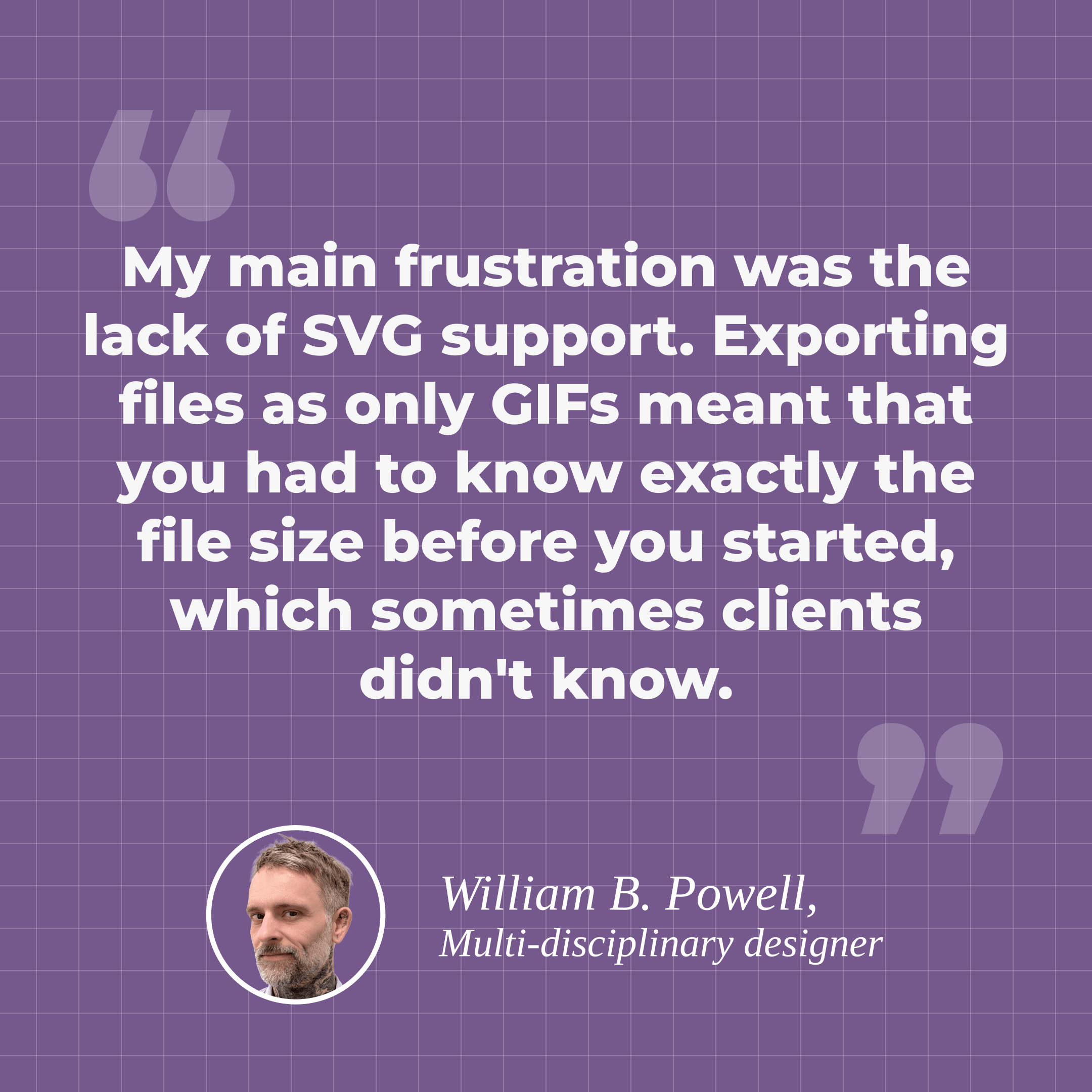
The output side had its own friction. After Effects didn’t support SVG export, so animations had to ship as GIFs. That meant locking in exact pixel dimensions before he started, which clients couldn’t always confirm upfront.
Covering the formats he actually needed required two separate Adobe tools running in sequence:
- After Effects for animation
- Media Encoder for the rest of the export pipeline
A tool that required formal training
Then there was the learning curve. After Effects is a deep tool, and getting fluent in it didn’t come from a few YouTube tutorials. William ended up taking a short course at a local university to learn it, an investment that paid off, but wasn’t repeatable every time he wanted to try a new tool.
He had also explored Rive for interactivity, since UX-focused websites often call for motion that responds to user input rather than just running on loop. Rive’s learning curve was steep enough to put that direction on hold.
By the time he started looking elsewhere, the case for change was clear. He needed a tool with a billing model that made sense for project work, native SVG export to match what clients wanted shipped, and a way to add interactivity without another formal course. Whether anything actually offered all three was the open question.
The Solution: SVG-native animations in a friendly interface
William’s shortlist of needs was practical:
- Native SVG export
- Multi-format output from one place
- A payment model for project work
- A learning curve he could clear without a course
- Built-in interactivity rather than just loop-based motion
SVGator covered each one. The browser-based interface meant no install and no local dependencies, with a monthly subscription option he could pay during active project months and pause during quiet ones.
SVG was the default export format, not an afterthought, which fit his clients’ need for assets that scaled cleanly to any size or placement. GIF, Lottie, and MP4 were available from the same export panel, replacing the After Effects plus Media Encoder combo with a single tool.
What he hadn’t expected was how quickly he could pick it up. After Effects had taken a course. SVGator, he learned by using it, one project at a time, without the YouTube deep-dive he’d assumed would be required.
His new workflow is tightened to three steps:
- Illustrator for asset creation
- Procreate for idea sketching and timing
- SVGator for animation and export.
Adobe Media Encoder dropped out entirely. After Effects stayed installed for legacy projects, but it stopped being the default.
The Results: Faster turnarounds and sharper creative focus
The most surprising shift wasn’t speed. It was focus. After Effects gave William so many options that he found himself adding extra effects, tweaking parameters, and chasing polish for its own sake.
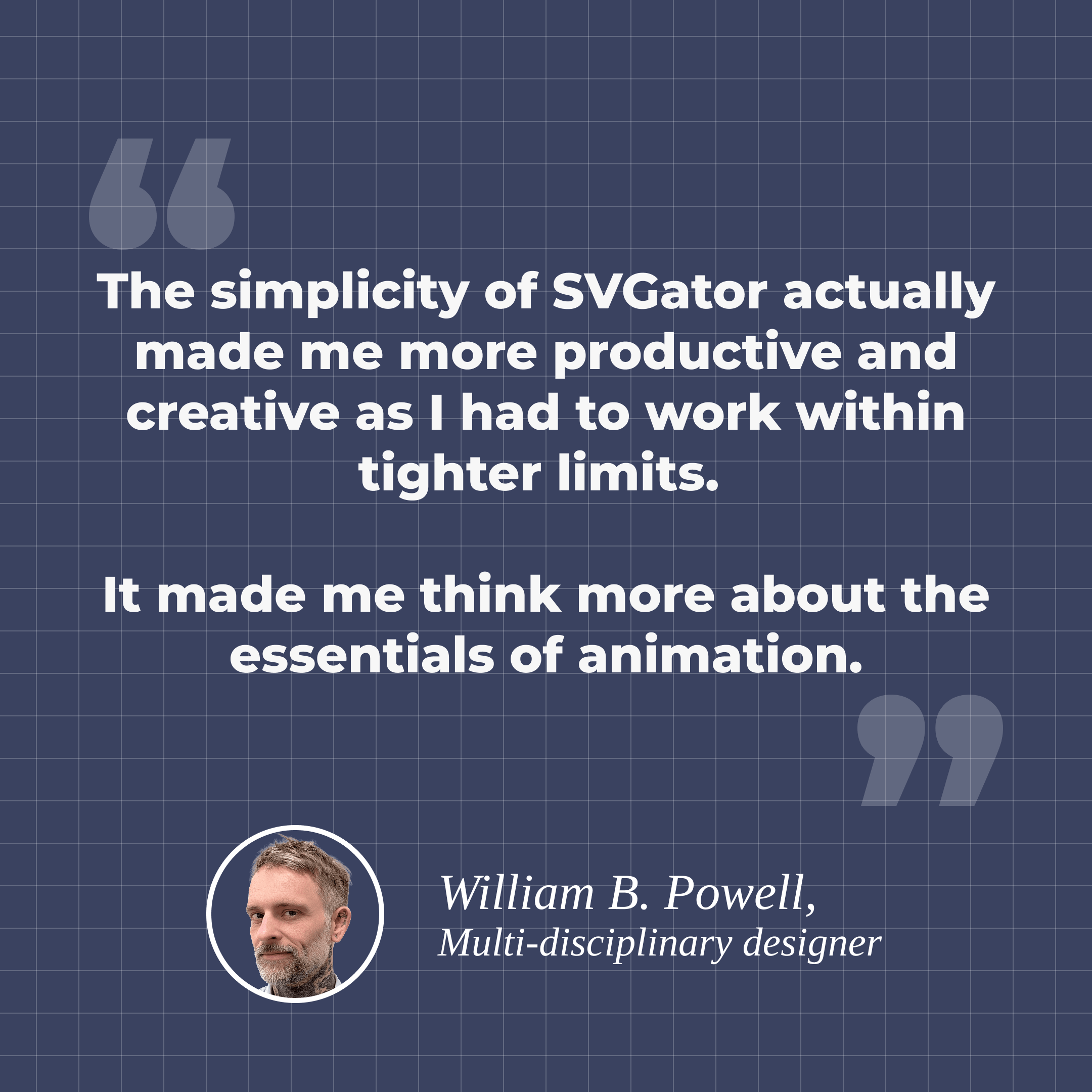
SVGator’s tighter feature set imposed a different kind of discipline. With fewer ways to keep tinkering, he started thinking harder about which animation choices actually served the piece, and which were noise. The constraint became the creative direction.
The numbers tell a quieter version of the same story. A typical animation that used to take a few days now wraps in roughly a day, including asset creation.
How clients felt the switch
Clients felt some of the change directly. SVG assets resized cleanly across placements, so the same animation could go on a hero section, a CTA card, and a mobile breakpoint without re-exporting at a different ratio.
The lighter file weight helped page performance, which the more design-savvy clients noticed and appreciated. None of it required a separate conversation about format. The assets just behaved better in production.
How William uses SVGator today
William reaches for SVGator about once or twice a week, mostly for website assets that add a small layer of life to a page, motion-based feedback for UX moments, and movement that pulls attention to a CTA without becoming a distraction.
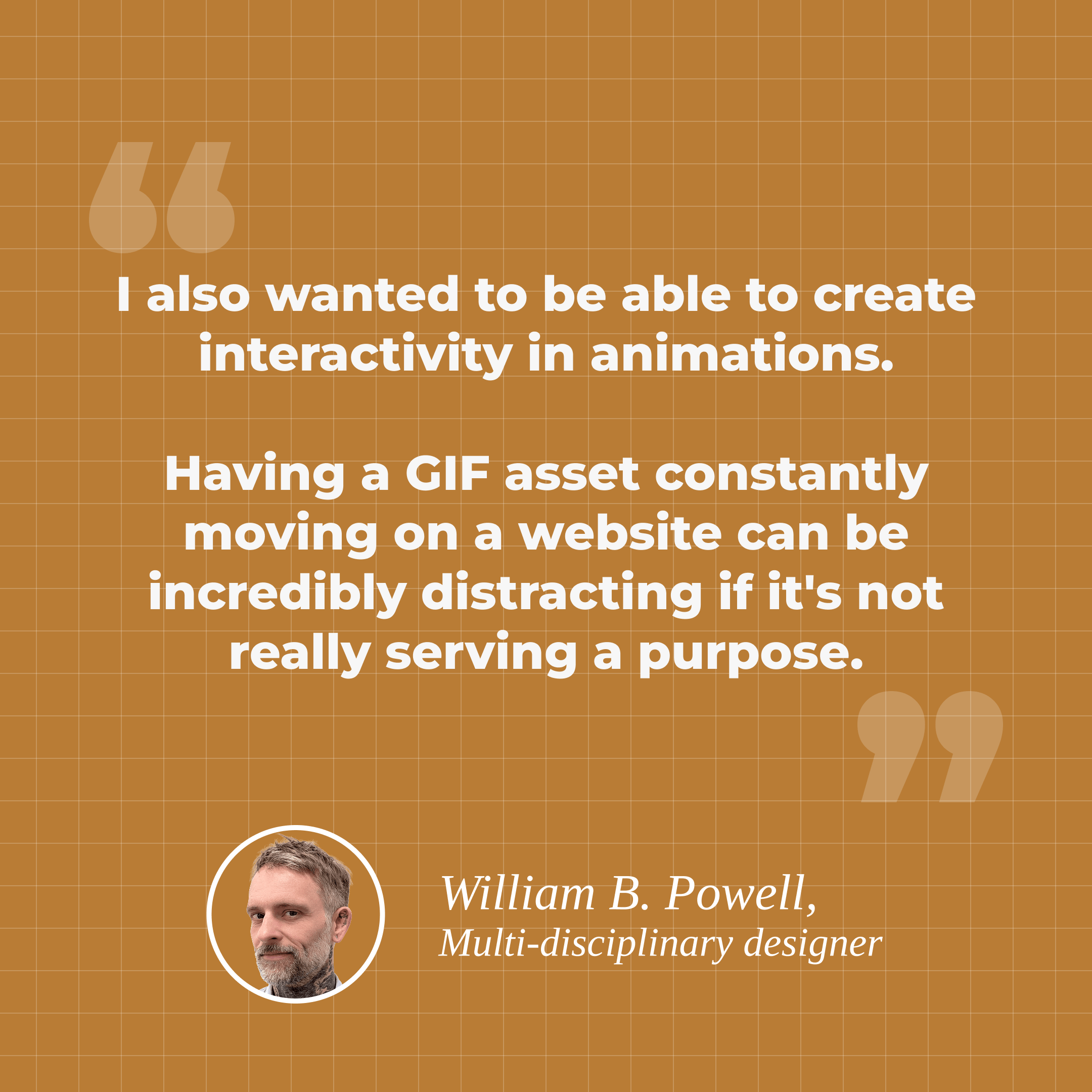
SVGator gives him the option to add motion when it serves a purpose, and skip it when it doesn’t.
Final thoughts
For independent creatives weighing whether to stay tied to a software subscription that doesn't fit their actual workload, William's workflow rebuild (like another independent UI/UX designer's experience) offers a useful counter-argument." The most-featured tool isn’t always the most productive one.
A tighter, more focused interface can get out of the way faster, and a billing model that flexes with project work fits the financial reality of freelance practice.